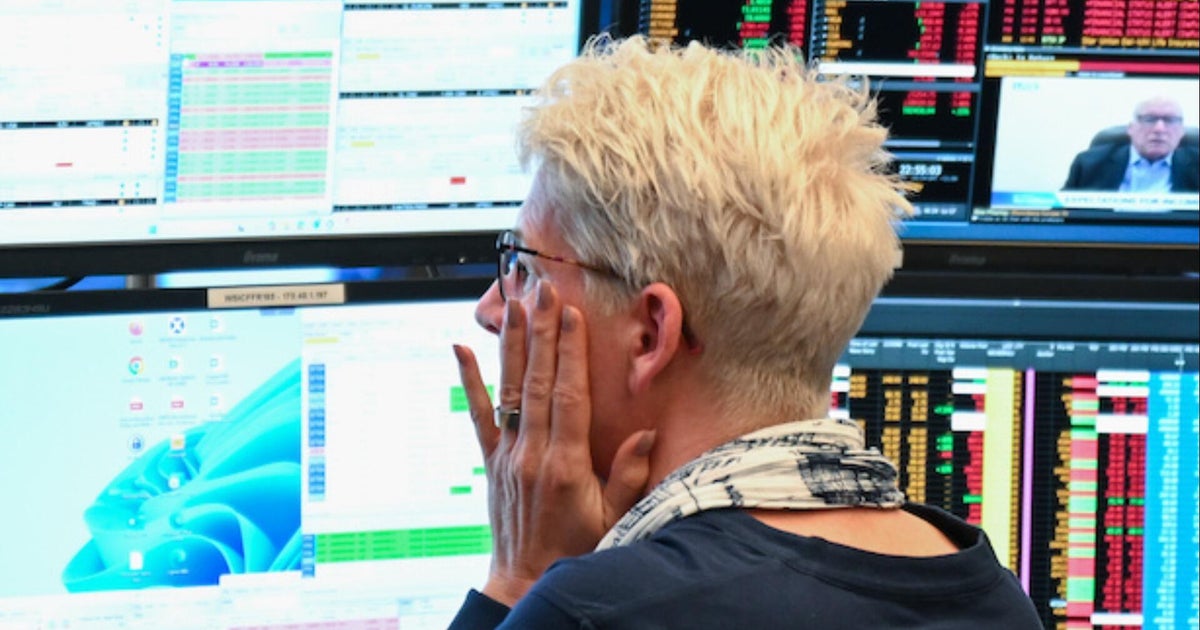
The stock market exploded higher on Wednesday after President Trump said he would place a 90-day pause on his reciprocal tariffs, adding that he would lower that rate to 10% for most countries effective immediately.
The Dow Jones Industrial Average surged nearly 2,200 points, or 5.8%, to 39,827 in afternoon trading, while the broad-based S&P 500 climbed 339 points, or 6.8%. The tech heavy-Nasdaq composite index jumped 1,300 points, or 8.5%.
One notable exception to Mr. Trump’s decision is China, with the president saying he’s increasing the tariff rate on goods imported from that nation to 125%.
“Based on the lack of respect that China has shown to the World’s Markets, I am hereby raising the Tariff charged to China by the United States of America to 125%, effective immediately,” he wrote.
Prior to the announcement, the S&P 500 had been down about 17% from its mid-February peak, pushing stocks toward a bear market, or when shares fall more than 20% from their most recent high, according to financial data firm FactSet. Investors have been spooked by Mr. Trump’s escalating trade war, which Wall Street economists warn could raise the risk of a recession and hurt U.S. corporations and consumers by hiking prices on products from almost every nation.
Even before Mr. Trump’s announcement, some on Wall Street had expressed optimism that the White House could back down from the reciprocal tariffs, which slapped rates of between 10% to 84% on U.S. trade partners.
“From a political perspective, even a few small concessions might allow [Mr. Trump] to claim success on a strategy to use these tariffs to bring down trade barriers,” Goldman Sachs analysts said in an April 9 report before the president’s 90-day tariff pause. “From a financial market perspective, it might provide a stronger signal to markets that these rates represent the top of the potential range of outcomes.”
China impact
Still, the trade war continues between the U.S. and China continues to rage. On Wednesday, China said it is raising its tariffs on U.S. products to 84%, up from its previously announced 34%, after President Trump’s import duties on Chinese good went into effect today at a rate of 104%. The retaliation signals Beijing isn’t backing down from Mr. Trump’s global trade war.
Mr. Trump’s broad-based reciprocal tariffs, which apply to imports of almost every nation, had kicked in after midnight Eastern time in the U.S.
Already, there are signs that some corporations are feeling the impact of Mr. Trump’s tariff policies, with Delta on Wednesday pulling its guidance for 2025 as the trade war depresses bookings across the travel sector.
“With broad economic uncertainty around global trade, growth has largely stalled,” CEO Ed Bastian said in a statement on Wednesday. “In this slower-growth environment, we are protecting margins and cash flow by focusing on what we can control.”
With corporate earnings season starting in the U.S., investors will be carefully watching the guidance from large companies such as Delta. On Wednesday, Walmart said it is standing behind its full-year sales and operating income outlook even amidst the growing trade war.
The nation’s largest retailer said that it expects first-quarter sales growth of 3% to 4%, but added that its range of outcomes has “widened due to less favorable category mix” and “the desire to maintain flexibility to invest in price as tariffs are implemented.”
contributed to this report.